Panthia®: Magic & Merge Game
- 4.5
- Rating
- 1.00M
- Installs
- Free
- Price

 Analysis by App-foxy
I went into Panthia®: Magic & Merge Game expecting a light casual game, and that is exactly where it fits best. Its appeal is not a complicated combat system or a demanding story campaign. Instead, it builds its experience around small actions, visible progress, and the pleasant urge to improve the board before putting the phone down. You merge objects, upgrade what you create, and gradually explore a magical world connected with fairies. The result is easy to understand, but it has enough forward motion to make “just one more move” feel natural.
That simplicity matters. Many casual games are enjoyable for a few minutes but feel disposable once the first novelty fades. Panthia has a clearer rhythm: I make a move, see the board change, receive a sense of progress, and then notice another unfinished goal waiting for attention. It is a compact loop, but the feedback is immediate enough to keep it moving. I would recommend it most to players who like tidy visual progress and relaxed decision-making rather than reflexes, competition, or long uninterrupted play sessions.
How the merge loop feels in actual play
I find the merge loop most satisfying when I treat each move as a choice about the board’s future, not just a quick way to make a higher-level object. Before combining pieces, I check whether the move will preserve room for another useful sequence; that small pause can keep a relaxed session from turning into awkward reshuffling. This kind of planning is what gives Panthia its gentle puzzle quality, and it also makes the gradual upgrade rhythm easier to appreciate.
You May Also Like

 Blood Strike: 2.5 Anniversary
Blood Strike’s Loadouts Turn Every Drop Into a Tactical Gamble
A close look at Blood Strike’s custom loadouts: how fast access to signature weapons reshapes its battle royale rhythm, rewards preparation, and narrows the gap between fights.

 Pandora - Music & Podcasts
Pandora’s Music Is Easy to Start, but Harder to Recover
Pandora’s strength is its low-effort path from a seed to a station. Its weak spot is how much confidence it asks you to place in connection, setup, and quiet recovery.

 8 Ball Pool
 Is Built on Rivalries, Rematches, and Routine
A close look at the rivalries, rematches, shared routines, and unanswered safety questions that turn a quick pool match into a persistent mobile community.

 Samsung Music
’s Quiet Strength Is Playing What You Already Own
Its reach comes less from spectacle than from dependable access to a personal library. That simplicity is both the app’s strongest retention engine and its ceiling.

 AccuWeather: Weather Radar
AccuWeather Review: A Quick, Clear Forecast for Everyday Decisions
For everyday plans, the best forecast is the one you can understand quickly. AccuWeather makes rain timing, radar, and local conditions easy to act on, with a few trade-offs.

 Hill Climb Racing
Why Hill Climb Racing Still Turns Crashes Into One More Run
A tiny car, a bumpy hill and one more upgrade: Hill Climb Racing keeps resurfacing because its simple chaos makes every near-miss feel personal.
More From Our News Desk
View All News


The first action is simple, but it sets up the whole game
The basic idea is easy to grasp: bring matching pieces together to merge them into something more advanced. That first action has a satisfying clarity because the board changes in a way I can understand immediately. I do not need to learn a large control scheme or remember a long list of commands. The game communicates its central rule through the objects themselves, which makes it approachable for someone who does not usually play mobile games.
What makes the opening move useful rather than merely decorative is that it creates a chain of decisions. After a merge, the space around it changes, a new object appears, and the available options look different. I am not simply tapping until something happens. I am deciding whether to combine pieces now, leave them in place for a larger combination later, or use a move to make room for another possibility. Even at its most relaxed, the board encourages a little planning.
I found it helpful to treat open space as a resource. A tempting merge is not always the best immediate choice if it leaves the board awkwardly arranged. When several matching pieces are available, I first look at which combination will preserve the most useful empty area. This is one of the game’s less obvious strengths: the challenge comes less from speed and more from keeping future choices alive.
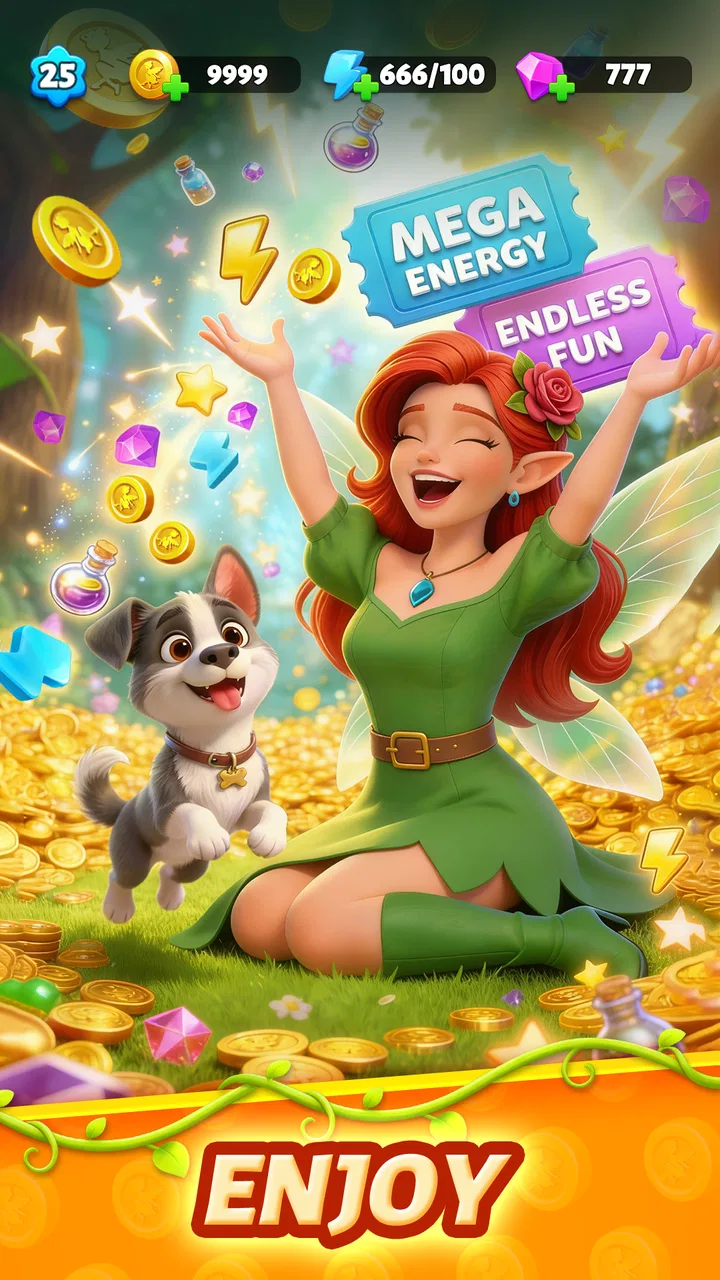
The fairy setting gives those movements a softer identity than a purely abstract puzzle. Panthia’s world is mystical and magical, but the game does not require me to understand a dense fantasy universe before I can enjoy the board. The theme supports the action instead of getting in its way. That makes it suitable for quick play when I want something visually lighter than a strategy game but more engaging than an idle screen.
Immediate feedback keeps a small move meaningful
The most important part of the experience is the feedback rhythm. A merge is followed by a visible upgrade, and that upgrade gives the move a reason to exist. I can see that the board is not static: pieces are becoming more valuable or more advanced, and the surrounding arrangement is evolving with them. This steady response is what turns a basic combination mechanic into a repeatable routine.
In my experience, the game works best when I focus on short sequences rather than trying to solve everything at once. I make one useful merge, check what it created, and then reassess the board. That pause between actions prevents the experience from becoming mindless. It also makes mistakes easier to absorb. If I use a space poorly, I can usually adjust my next choices instead of feeling that the entire session has been ruined.
The feedback is especially effective during ordinary spare moments. I can imagine opening it while waiting for an appointment, taking a few turns during a break, and closing it without needing to remember a complicated tactical position. The game’s casual category is a good fit here. It asks for attention, but not the kind of concentration demanded by a competitive match or a timed action game.
There is also a useful mental shift that improves the experience: I stop judging every move by its immediate reward. Sometimes the best move is the one that organizes the board for a later merge. That creates a gentle trade-off between short-term satisfaction and longer-term efficiency. Players who enjoy arranging, sorting, and gradually improving a collection will probably notice this layer quickly. Players who want every tap to produce a dramatic result may find the pace too modest.
Upgrades provide the reward, but progress is deliberately gradual
The reward structure is built around transformation. A low-level item does not remain an isolated object; it becomes part of a visible progression toward something better. That gives even a small session a clear endpoint, whether I am trying to complete one more merge or improve the state of the world before leaving.
I like that the reward is connected to my action rather than being completely separate from it. The board itself shows the result of planning. When I create an upgrade, I can trace it back to the choices that made it possible. This makes progress feel more personal than simply collecting a number that rises in the background.
At the same time, the gradual pace is a limitation for anyone who expects rapid unlocking. Panthia is not the right choice if you want a constant stream of major discoveries or a deep competitive ranking system. Its satisfaction comes from accumulation. The game asks me to appreciate small improvements, and that can feel repetitive if I am in the mood for a faster or more dramatic experience.
The free entry point makes it easy to try without committing money first. Panthia is free to download and play, although it includes optional in-app purchases ranging from $0.99 to $99.99 per item. That range is worth keeping in mind before handing the phone to a child or allowing unrestricted purchases. The game is marked for Everyone, but an age-friendly rating does not remove the need for sensible purchase controls.
Why another session begins after I close the game
The reset between sessions is part of the design’s appeal. I can stop after completing a useful merge, then return later with a board that still suggests unfinished possibilities. The game does not need to end every visit with a dramatic victory. Instead, it leaves behind a small amount of visible incompleteness: a space to organize, an upgrade to pursue, or a new part of the magical setting to explore.
That makes Panthia particularly suitable for fragmented time. A realistic use case would be an evening when I have ten quiet minutes before bed. I open the game, make a few careful combinations, clear an awkward section of the board, and stop once the next decision would require more attention than I want to give. The session feels complete enough to be satisfying, but not so final that returning tomorrow feels pointless.
The same reset can work against the game. If I prefer a clear finish line, a campaign with defined stages, or a match that ends decisively, the open-ended merge flow may seem vague. There is no reason to expect this game to replace a traditional puzzle campaign or a more structured adventure. It is better understood as a continuing board that rewards repeated visits rather than a sequence of self-contained challenges.
My practical advice is to decide on a stopping point before the board becomes cluttered with possibilities. I often get more enjoyment by ending after a clean upgrade than by continuing until every available space feels difficult to manage. That habit keeps the next session inviting instead of turning the game into a chore. It is a small change, but it improves the reset-and-return rhythm considerably.
What makes it different from familiar casual alternatives
Compared with a standard match-three game, Panthia feels less focused on clearing a fixed arrangement in a limited number of moves. The emphasis is on building and upgrading objects over time. That changes the emotional pace: I am not primarily chasing a high score or trying to survive a difficult level. I am shaping a board and deciding how efficiently its pieces can develop.
Compared with an idle game, it gives me more direct control. Progress does not feel entirely automatic because my placement and timing matter. I have to participate in the transformation rather than simply checking in to collect an accumulated reward. On the other hand, it is less demanding than a management game that expects constant optimization, detailed resource accounting, or long planning sessions.
Compared with a story-heavy fantasy game, the fairy world is a backdrop for the merge experience rather than the main reason to play. I would choose Panthia when I want a magical atmosphere without committing to dialogue, combat, or a large narrative system. I would choose something else when I want character development, exploration controlled by movement, or a strong plot to carry me from one session to the next.
That positioning explains both its strength and its weakness. The game is unusually easy to pick up for a merge title, but its relaxed structure may not satisfy players searching for depth in the traditional strategy sense. Its best audience is someone who enjoys incremental goals, visual organization, and a calm loop that can be paused at almost any point.
Small habits that make the board easier to manage
My first useful habit is to avoid spending every matching piece as soon as it appears. Leaving a pair or group available can create a better follow-up than taking the first obvious merge. I also try to keep a central area flexible, because filling every corner makes later combinations harder to arrange. These are simple choices, but they turn random-looking movement into deliberate board management.
A second habit is to inspect the result of each upgrade before making another move. The new object may change which pieces are worth preserving, and rushing can hide a better sequence. Panthia’s feedback is quick, so taking a moment to reassess does not slow the game much. It simply makes the loop feel more thoughtful.
A third is to separate progress goals from session goals. My longer goal may be to develop the world and create stronger objects, while my immediate goal is only to free a crowded section or prepare one promising combination. This prevents a short break from feeling unsuccessful just because I did not reach a major milestone.
These tactics also reveal the main trade-off. Careful play is more rewarding, but it can make the game feel slower. Fast play is lighter and more spontaneous, but it may produce clutter and reduce the number of good options later. Neither approach is wrong. The right balance depends on whether I am using the game as a quick distraction or as a quiet puzzle to think through.
Who should try it, and who should skip it
I would point Panthia toward casual players who like merge mechanics, fantasy presentation, and gradual improvement. It is also a good fit for someone who wants a game that can be played in short bursts without demanding reflexes. The Everyone rating broadens its appeal, and the controls are approachable enough that a newcomer can understand the central action quickly.
I would be more cautious recommending it to players who dislike repetition, want a firm ending, or need constant novelty. The same loop that makes the game calming can become predictable. If your favorite mobile games are competitive shooters, intricate role-playing adventures, or puzzle titles built around increasingly difficult timed stages, this may feel too gentle.
Purchase-minded players should also decide how they feel about optional spending before they begin. The free version makes trying the game straightforward, but the presence of item purchases means I would review device purchase settings in advance, particularly on a shared family device. That is not a criticism of the merge mechanic itself; it is simply part of using a free casual game responsibly.
Performance context and the long-term impression
Panthia comes from Playorcas and has built a substantial audience, with over a million installs, an average rating of 4.6, and around 85 thousand ratings. Those figures suggest that the straightforward merge formula has found a receptive audience, although popularity alone does not guarantee that its slow-burn structure will suit everyone.
The game was released on November 1, 2023, and the current version is 2.59.0. It supports devices running Android 7.0 or later. For someone deciding whether an older Android phone can run it, that minimum requirement is the practical detail to check first. I would also keep the game updated when possible, since casual titles often depend on a stable relationship between their board progression and the surrounding content.
After spending time with it, I see Panthia as a carefully focused casual game rather than a broad all-purpose fantasy experience. Its action is clear, its feedback arrives quickly, its rewards are easy to read, and its unfinished board gives me a reason to return. The reset is not a hard restart; it is an invitation to continue shaping what I left behind.
My verdict is simple: choose Panthia if you want a calm merge game where small decisions steadily build a magical world. I would not install it expecting a deep adventure or a dramatic challenge. I would install it for those spare minutes when I want something more involving than an idle distraction but less demanding than a serious strategy game. The loop succeeds because each session ends with just enough progress to feel worthwhile and just enough possibility to make the next session tempting.
FAQs for Panthia®: Magic & Merge Game
01What is the main objective of Panthia®: Magic & Merge Game?
Panthia®: Magic & Merge Game challenges players to combine magical elements to solve puzzles and progress through increasingly complex levels. The goal is to merge various mystical items to unlock new spells, characters, and realms, providing both a strategic and engaging gaming experience. Each successful merge opens up new possibilities and rewards.
02Are there any in-app purchases in Panthia®: Magic & Merge Game?
Yes, Panthia®: Magic & Merge Game offers in-app purchases that enhance gameplay by providing additional resources, special items, or boosts. While the game can be enjoyed without spending real money, these purchases can expedite progress or offer unique customization options for a more personalized gaming experience.
03Is Panthia®: Magic & Merge Game suitable for all ages?
Panthia®: Magic & Merge Game is designed to be family-friendly and is suitable for a wide range of ages. The game features enchanting graphics and easy-to-understand mechanics, making it accessible for younger players, while the strategic elements and complex puzzles provide a challenge for older audiences.
04Does Panthia®: Magic & Merge Game require an internet connection?
Panthia®: Magic & Merge Game can be played both online and offline. While an internet connection enhances the experience by allowing access to social features, updates, and multiplayer modes, players can enjoy the core gameplay offline, making it convenient for gaming on the go.
05How frequently does Panthia®: Magic & Merge Game receive updates?
The developers of Panthia®: Magic & Merge Game regularly release updates to introduce new content, features, and improvements. These updates often include new levels, characters, and seasonal events, ensuring that players have fresh and engaging content to explore on a consistent basis.
Pros
- Engaging storyline keeps players hooked.
- Vibrant graphics enhance the visual experience.
- Intuitive controls make gameplay smooth.
- Regular updates introduce new challenges.
- Free to play with optional in-app purchases.
Cons
- Requires constant internet connection.
- Some levels can be repetitive.
- In-app purchases can be pricey.
- Occasional ads may disrupt gameplay.
- Limited offline features available.

Panthia®: Magic & Merge Game
Gallery